

Bearing Installation
Replacing cartridge bearings
(not simple as it may seem)
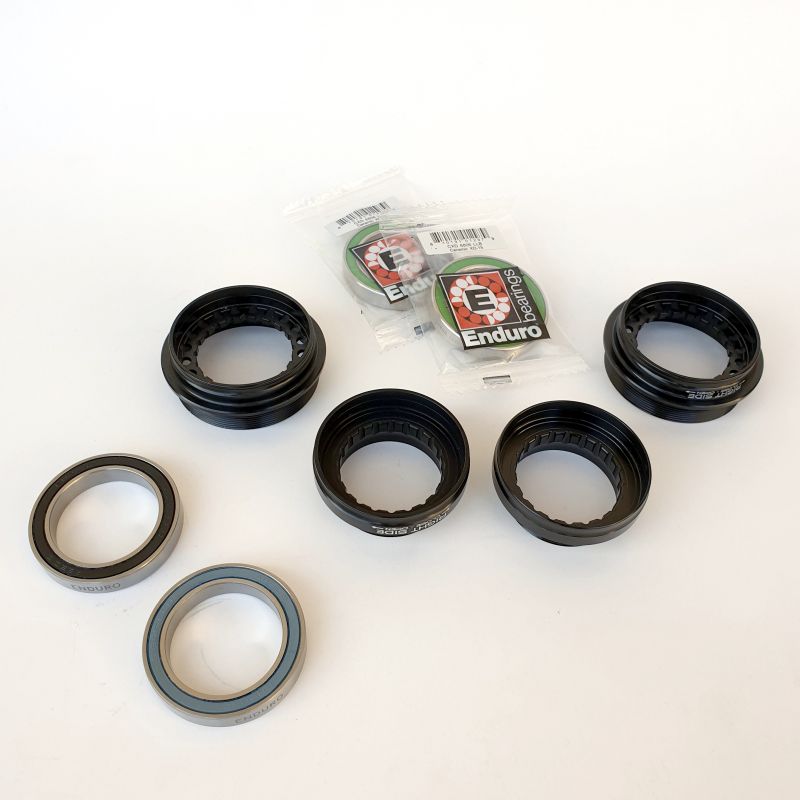
Extralite hubs employ beefier bearings than the majority of our famous competitors.
Bigger bearings are mounted onto axles of a bigger diameter. This creates a stiffer assembly that significantly increases bearing durability.
Our MTB hubs feature also additional external seals to keep moisture and dust far from the 2RS bearing seals.
Read well these info before ordering new bearings.
Bearing replacement is not an easy operation as it may seem.
Here below you'll find the basics on how to manage properly a cartridge bearing.
If you simply pop in a set of new bearings chanches are that they get damaged right from the start.
Additionally the installation of any kind of Hybrid & Ceramic bearings requires a really good specific expertise.
If your hub was originally equipped with standard bearings it will probably require micro-tolerance adjustments to axle and bearing fittings,
this to allow proper bearing rotation and durability (but these operations are for real experts only).
Alternatively send your hub to us for a proper servicing.
Extralite Factory Installed Bearing Options
 |
 |
 |
 |
See here pro and cons for each type.
Removing a Worn-out Bearing
Unfortunately in most cases when you have to extract a hub bearing you can only push it out from its internal race.
This operation will generally damage or compromise the bearing races, however, if you are going to replace a worn-out bearing with a new one, that's a marginal problem.
Removing a Bearing that's Still Good
In case you wish to re-install a previously-used bearing you'll need to extract it in a much safer way. Avoid hitting the internal race with a mallet at all. Even a threaded extractor or a bench-press can damage the bearing races.
Try instead to warm up the hub-shell with a hairdryer to facilitate an easier extraction of the bearing. The heat expands the alloy hubshell more than the bearing steel allowing to gently push it out by hand pressure.
This will also soften Loctite (or other coaxial glue) that could have been eventually applied in the original assembling at the factory .
Inserting a New Bearing
A new bearing should always be inserted by pressing it on the same race that's going to be pressed into the fitting.
Cartridge bearings are generally fitted into the hub-shell with some interference on the outer bearing race, in all these cases apply pressure only to the external race of the bearing.
Note that the pressure should be applied exclusively onto the outer race, do not push flat on both races. Pressure or hits on the bearing internal race will permanently damage the balls and races of your new bearing.
To properly press in a new bearing its normally used a specific insertion tool. Use only an inserting tool that is made for your exact bearing size (each bearing size needs a tool of its specific diameter).
Extralite offers complete tool-sets for hub maintenance too; both Pro-tool kit 1 and Bearing-sitter include bearing inserting tools in the bearing sizes used on 'Hyper' and 'Cyber' hub families.
Using an Old Bearing to Protect the New One
As a last resort, in absence of proper inserting tools, you could use the old bearing to carefully press in the new one as follows (use this method for emergency only)
- carefully position the new bearing on its fitting
- align the old bearing perfectly onto the new one
- with a plastic mallet push it in hitting only the external race of the worn bearing
- press the bearing in small increments and periodically make sure it's getting in perfectly flat.
- make sure the cartridge has reached it's final position contacting the bore end-shoulder, than do not over press.
Axle insertion
As your new bearings are finally in their correct position remind that the hub axle has to slide into the bearings with only a mild pressure (the pressure amount is directly related to the bearing side-load capacity).
Forcing the axle through the bearings can again permanently damage balls and races of the new bearings.
Hub-Shell / Cartridge Bearing Interference / Basic Criteria
As general rule the pressing interference between hub-shell and bearing should be around 0.01mm.
An interference of 0.02mm applied on a thin bearing (ex. 6802 - 6803 etc.) can compromise the ball-to-races tolerance.
On high quality bearings the matching/coupling of the parts leaves 0.003-0.010mm of play between balls and races before the installation.
If the races get pressed by a excessive pressure of the fitting bore or by the axle inserting the balls will rub against their races and won't rotate smoothly, this brings to premature wear too.
The opposite case of a slightly loose bearing fitting can generally be properly dealt using Loctite 638 - 648 - 680 - 6300 / Loxeal 83.21 / Arexons SYS56A41 or equivalent "coaxial coupling" products.
Apply just a shade of coaxial-coupling product both on the bearing outer surface and inside its fitting on the hub.
In case of an eventual future replacement it will require to warm up the parts to 60° with an hair-dryer.
Hub-Shell / Cartridge Bearing Interference / Extreme case
In case the gap between the cartridge bearing and its hubshell fitting got higher than 0.05mm (0.10mm max) its still possible mount the bearing at "epoxy fitting".
The orrect execution of this procedure requires the following care:
1) wipe an extremely thin shade of oil on the outer bearing surface, clean any excess
2) perfectly degrease the bearing fitting in the hubshell and warm it up to ca 40°
3) apply a thin layer (0.2-0.3mm) of epoxy glue on the whole bearing fitting surface
4) inset the bearing and keep it in position for the next 24h, then reassembly the hub normally
Use only hi-quality epoxy glue (2 parts) as example JB weld / Loctite 660 / 3M 490 or equivalent.
Following this procedure the hub functions remain optimal.
Using 440C stainless bearings or the hyper durable XD-15 is generally highly recommended.
If properly executed an eventual future bearing replacement will require only to warm up the parts to 60° with an hair-dryer.
Then it will be possible to insert the new cartridge without repeating the whole glueing process.
Hybrid Ceramic Bearings
The installation of ceramic bearings is quite demanding and requires a very good specific expertise since those expensive bearings require an even more precise tolerance match.
A proper bearing and axle insertion is critical when you are planning to mount hybrid-ceramic bearings. The ceramic balls feature a very hard surface that can ding the steel races very easily.
Excessive interference of the bearing outer-race with its hub shell fitting will often result in a rough-rolling bearing. The same happens when the axle requires too much pressure to be slid into the bearing's inner-race.
Both these conditions compromise bearing effectiveness and durability right from the start.
Note: If your hub was originally equipped with standard bearings, axle and bearing fittings it will probably require micro adjustments of their fitting tolerances in order to allow a proper bearing rotation and durability (these operations are for real experts only).
Alternatively send your hub to us for this servicing.
Seals Stiction
Bearing seals are generally the first responsable of bearing durability.
Tighter seals increase friction when brand new, however do not over-estimate that initial effect.
Rubber seals beak-in and seat quite rapidly, so wait before judging. Additionally note that the effective bearing friction shouldn't be judged simply rotating the axle with your fingers, that shows only seals and grease stiction.
Do not get excited by silly advertising of a bearing that spins for minutes in seller's hand, that's the effect of absent lubricant and non effective /non existent seals (pure bullshit).
Good seals are a must for any smooth performing and durable bearing.
Real Friction under use
In the real world bearings get highly loaded by chain-pull, rider weight etc. and that's the only cause of a real friction. When the bearing spins its balls rotate under load, but balls are also forced to slightly rub between races.
This causes friction and heath in a much greater q.ty than what a properly-fitted protective seal could ever do. Rubber lip-seals help keeping your bearings clean and smooth for a longer time. This is the one of the reasons why harder races with quality ceramic balls offer a performance advantage over others.
Bearing Durability
A quality Abec-5 steel bearing mounted on any Road Extralite hub can last for a really long mileage, we have serviced several properly kept hubsets with over 40.000Km of usage with their original bearings still in good conditions.
Bearing durability is related to a great number of factors such as seal type and their conditions, bike washing mode and frequency, bike use and environment, hub maintenance and more. All that makes each individual case quite different.
However note that water and moisture left inside any bearing after bike washing will soon start to corrode the bearing races of any steel or hybrid-ceramic bearing if the bike get parked and not used again for days or weeks. Keep this simple rule well in mind!
The only exceptions to the above happen with fully stainless bearings and XD-15 bearings. In highly corrosive environments the XD-15 ceramic balls resist to corrosion and help to clean their races that are made with an extremely hard non-corrodible steel.
Ceramic Bearings
Bearing Friction
Bearing friction should be judged under load when the balls rub and rotate between races. In these circumsances the use of hybrid ceramic bearings can offer an advantage.
Today’s Quality Standards
Hi-end bearing manufacturers have now acheived much higher quality standards than only few years ago. Quality hybrid ceramic bearings are now made with incredibly hard steel races that can survive the coupling with ceramic balls for a much longer life.
Durability
The latest generations of hybrid-ceramic bearings, such as ABI Zero and HDC, offer durability comparable to a steel unit. Earlier generations of bearings could only offer a fraction of the durability of a regular steel bearing.
In highly corrosive environments the ceramic ball resists corrosion and helps to clean the hard steel races. In such circumstances the overall durability could be even higher than steel bearings, however this is generally an uncommon situation.
Advantages and Disadvantages
Do not over-estimate the advantages of hybrid ceramic bearings. Their durability is equal or lower than steel ones, price is higher,all to gain a slightly lower rolling resistance.
When you are choosing to use hybrid-ceramic bearings be aware that the lower rolling resistance is the sole advantage they can offer besides a very very slight weight reduction (ca 1gr. less on each hub bearing).
Beware of Cheap Gimmicks
To enhance the feel of low-rolling resistance some non-serious manufacturer equip their bearings with non-contact seals and zero lubricants. Then you can see them spinning for minutes but that's just for fun; an absolute fake.
Those bearings in reality can last only few rides in the real world as they let dirt get directly into their ball races.
Full-ceramic Bearings
Some bike enthusiasts have tried to employ full-ceramic bearings in order to save weight and further reduce rolling resistance. Unfortunately with today's technology a properly dimensioned steel bearing cannot be replaced with a full-ceramic bearing of the same dimensions. Size should increase commensurately when moving from steel to ceramic and this requires a specifically designed hub-shell and voids any weight saving.
Additional note: even full-ceramic bearing manufacturers are openly not recommending their products for bicycle applications due to the material fragility. Typical bicycle applications involve high impact resistance at low rpm (10-100 rpm) while the typical full-ceramic bearing applications are on very high rpm (over 20,000 rpm) under low impacts.
Load ratings of ceramics bearings
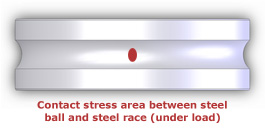
Ceramic has a higher modulus of elasticity than that of high carbon chrome bearing steel.
Therefore in aceramic bearing the lower deformation of the balls (or rollers) generates higher stress at the contact point between the balls and races than in a conventional fully steel bearing.
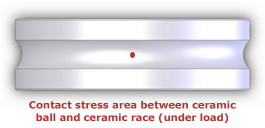
|
Bearing type
|
Dynamic load
|
Impact load
|
|
Hybrid ceramic
|
ca. 80% of steel bearing
|
ca. 70% of steel bearing
|
|
Full ceramic
|
ca. 80% of steel bearing
|
ca. 20% of steel bearing
|
Load ratings of ceramic bearings compared to steel bearings.
It's absolutely necessary fit a sensibly larger load rating capacity bearing when using a full ceramic bearing for any bike application. Due to the brittleness of ceramics, full ceramic bearings are not capable of withstanding impact loads.
The outer races or inner races will generate cracks or even suddenly break under a certain amount of impact load fully locking the rotating assembly, extremely dangerous.
Bearing inserting tools
In many years of designing, manufacturing and assembling hubs we developed several tools for the bearing fitting.
Recently we also released a small and minimalistic kit that can offer very good results for beginners and end-users too: see Bearing Sitter Kit
Bearing inserting tools vs press
A bearing press may look very cool but isn't the right tool for inserting new bearings at all.
That especially on hi-end lightweight hubs.
Here few reasons why the press isn't good as it may seem (there are many more):
- Bearing never get in really straight and well sit on the fitting shoulder.
- Doesn't give a good feel of the level of interference between the bearing and its fitting.
- Additionally a press mayeasily deform a lightweight hubshell.
Individual inserting tools (for each exact bearing size) used with a tiny plastic mallet offer the best results.
Obviously this requires a bit of skill and sensitivity but these qualities are anyway necessary for a correct handling of cartridge bearings and for the hub-servicing in general.